


Frequently Asked Questions:
- UHMWPE Lines- What are they and are they all the same even if they look the same?
- How do I rig my sliptip?
- How do I load my sliptip?
- What should my gun look like after it's setup?
- What are all these diffrent parts?
- What should I know about bands?
- What is a loading tab and how does it work?
- How do I install bands?
- How do I remove bands?
- Aiming
- Aiming a midhandle type speargun
- How can I sight in my speargun? And what can I use?
- Open Track VS. Semi Enclosed Track
- Size of Spear Gun
- Reel Vs. Float Line
- Spring steel shafts vs stainless shafts
- Mixed Woods
General
UHMWPE Lines- What are they and are they all the same even if they look the same?
Here is some basic information about the different types of lines you'll find out there.
The answer is a simple no!
UHMWPE is Ultra High Molecular Weight Polyethylene. Often incorrectly called HMPE or High Modulus Polyethylene. The nomenclature is important as that is what differentiates the fibers. The stronger the individual fiber the higher the molecular weight (or length of molecules) in the fiber. Calling a fiber UHMWPE is like lumping all steel cables into the same category, and as I am sure those of you that work in salt water understand, all steel cables are not equal. There are many types of UHMWPE, the best known are from either Honeywell "Spectra" or from DSM "Dyneema". Its important to understand that not all Spectra fibers are the same, nor are all Dyneema fibers the same. Fiber diameter is referred to in terms of Denier and the same Denier fiber can very in strength by up to 40%. So in fact you can get up to a 40% difference in strength in lines of the same diameter, with the same basic construction, but made with different classes of fiber. Within those classes are in some cases up to 3 grades for each denier. Spectra (USA) has 4 classes of fibers with various grades for each fiber. Dyneema (Europe) has 7 classes of fibers. So it is anything but straight forward with it comes to Spectra and Dyneema fibers. The main difference between Spectra Fibers and Dyneema fibers is the number of filaments that make up a single denier (or thickness) of fiber. Dyneema has more fibers per denier giving it a softer hand as each filament can slide past the next when bending. Spectra has fewer fibers per denier making it harder to break the individual fibers and therefor making it less likely to "Fuzz Up". If a line is not made of either Spectra or Dyneema then it is referred to as generic UHMWPE or incorrectly HMPE. This fiber typically comes from China and there is only one low grade. The single grade of fiber from China has much more variability in the diameter of the individual filaments that make up the fiber, making the fiber have a much greater variability of strength for a particular denier. These fibers are typically used as fillers in the core of products or in situations where variability in the breaking strength and abrasion resistance of the line are unimportant. In terms of fiber cost Spectra is the most expensive, followed by Dyneema and then much cheaper (by up to 3 to 4 times) is Chinese UHMWPE. So it's important not to assume that just because a line looks similar that it will perform the same.
The next thing to consider is construction, and this is where even using the same fiber two lines can perform completely differently. It typically takes months of testing, both in the lab and under real world conditions to make a line that meets a customers criteria. Remembering of course that if you ask 10 people what the ideal line is, you will probably get close to 10 different answers. More complex constructions and tighter braids require more sophisticated braiders and greater knowledge of how fibers work together to produce. More complex constructions are also slower to produce making them more expensive, even when made from the same fibers. Typically the tighter the braid the more abraision resistant it is and the more fiber you use due to loss of length due to braiding. The more linear the fibers the more strength you retain. Engineering a line for a specific application (other than very light lines under say 200 lbs) usually requires a combination of both linear or near linear fibers for strength and a tight over-braid for abrasion resistance and resistance to tangling or water-knotting.
The third component of well engineered lines is the coating or impregnation of the line to minimize salt water penetration and maximize abrasion resistance. Polyurethane is the typical coating used although again all polyurethanes are not formulated to perform the same. Q-PowerLine utilizes a proprietary formulation specifically for salt water spearfishing line use that is only found on Q-Powerline products.
You get what you pay for!
How do I rig my sliptip?
This setup prevents the slide ring from going to the end of the cable and holding the slip tip on the adapter. It also prevents the slid ring from moving down the shaft and ending on the track portion of the gun.
1: Use Teflon tape to cover threads.
2: Put a few wraps of electrical tape about 2in from threads.
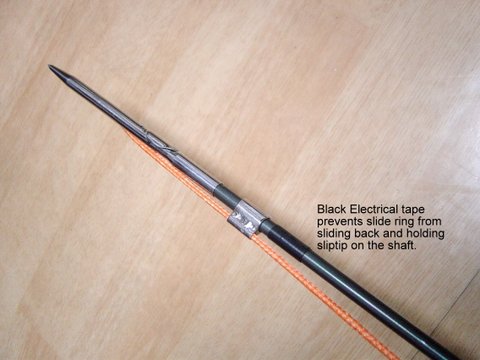
3: Put slide ring on shaft.
4: Screw down Sliptip adapter.
How do I load my sliptip?
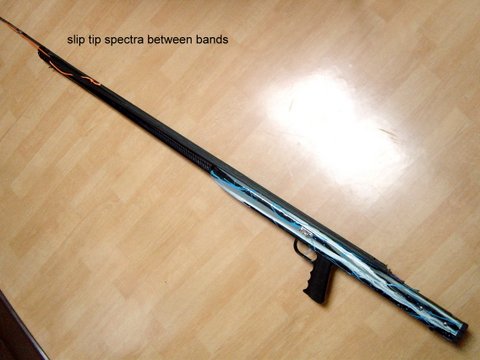
1: To load the slip tip on your gun, load the bands first.
2: Then seat the slip tip on the male adapter.
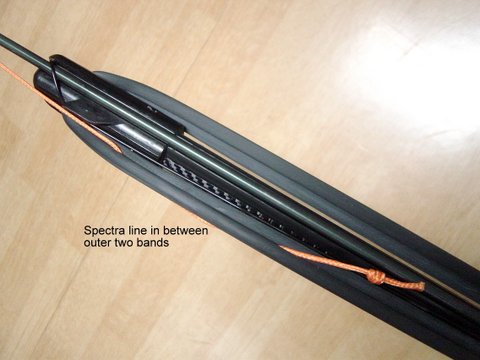
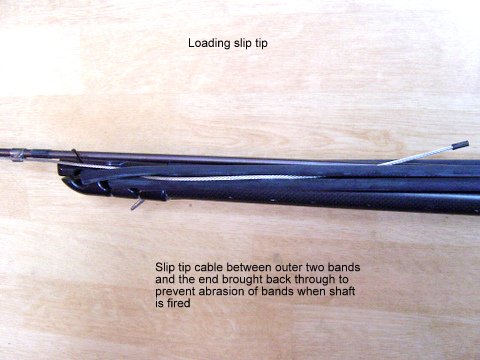
3: Then take the end of the cable or Spectra and pull it between the outer two bands until it is snug and holding the slip tip on the adapter.
4: Then pull the end of the cable or spectra back through the bands so that there is only a short section of the cable or spectra between the bands. This prevents the cable from abrading the bands when the shaft is fired.
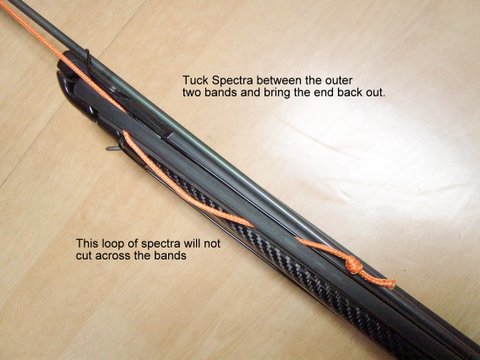
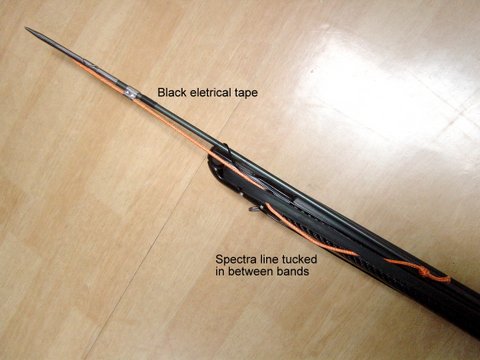
What should my gun look like after it's setup?
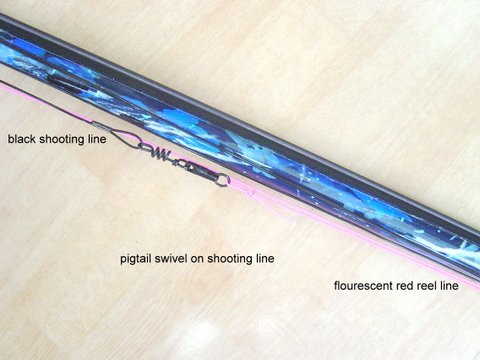
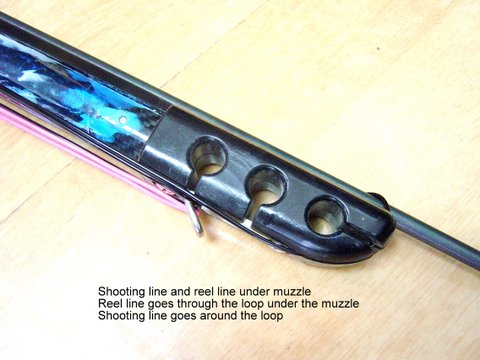
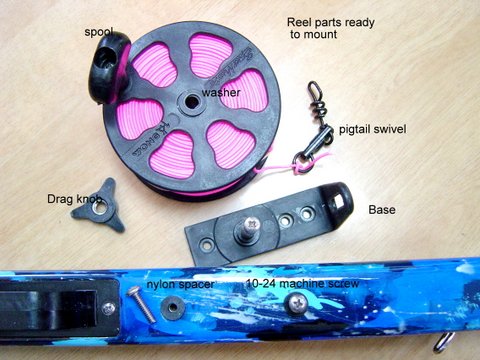
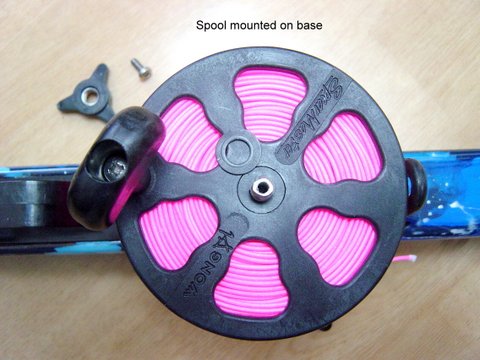
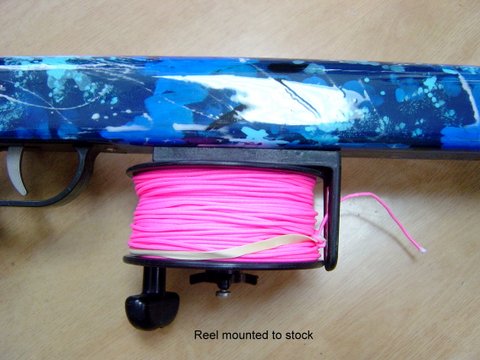
These are pictures to help rigging your gun and installing a reel.
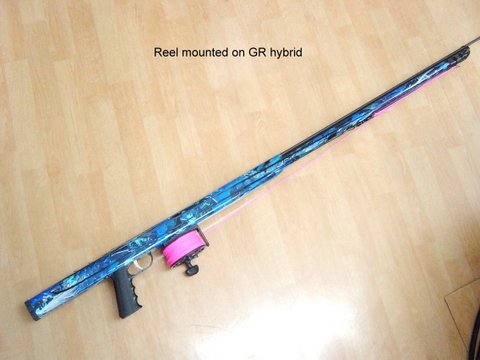
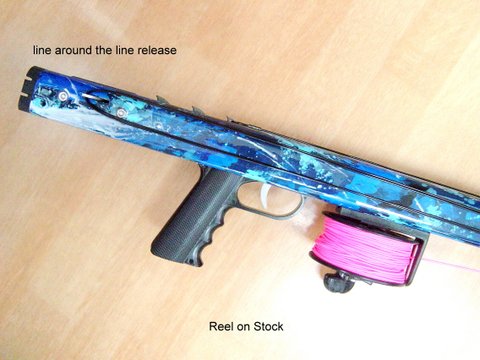


What are all these different parts?
These are a few pictures of the different parts of the speargun and the common terminology use to describe them.
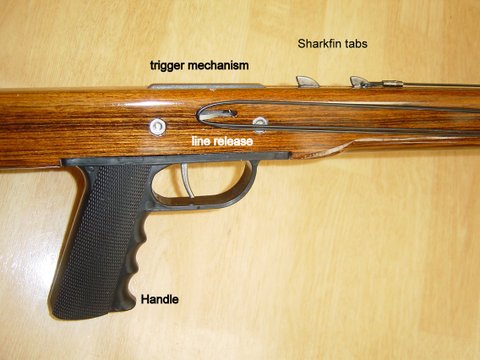
Line release holds the line when the shaft is loaded. It is released forward and the line goes free when the shaft is fired.
Shark fin tab is the tabs on the shaft that the bands are loaded on.
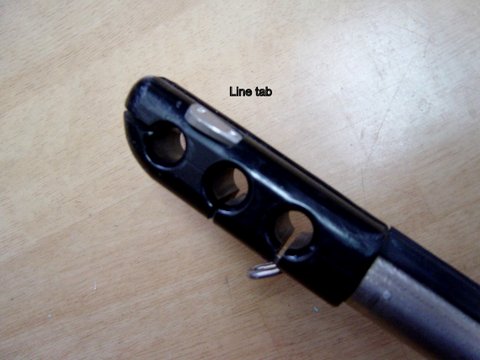
Line tab is on the muzzle to hold shaft line on the muzzle as the line holds the shaft.
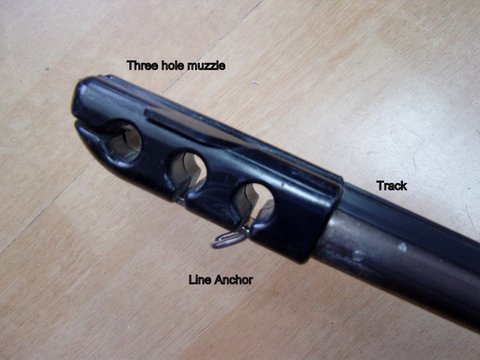
Muzzle is injected molded high impact polymer.
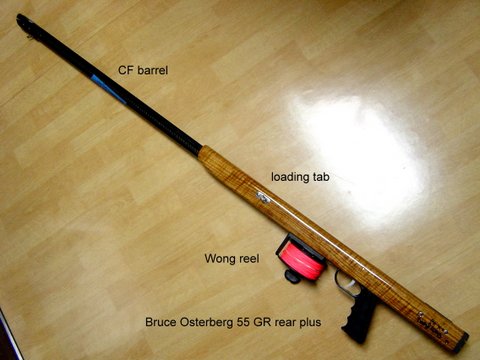
Carbon fiber barrel is made of .100 in wall thickness for optimum rigidity.
Bands
What Should I know about bands?
Bands Are Not Created Equal
There is always ongoing tweaking of gear by divers to try and get that little bit of edge with their equipment. That is only natural because the better our gear works the more fish we shoot. The single most important piece of gear in our harvesting of fish is our gun. There are hundreds of different guns out there but they all have one thing in common. The guns shaft has to be powered by something...whether it be compressed air, explosive material, or bands. Band powered guns are by far the most popular, whether you have a production gun, a euro-style gun, or a custom gun.
There are several ways that latex bands can be made. The two most common are:
1. EXTRUDED - This is the most common way of manufacturing. It is made by pushing Latex powder through an extrusion machine under heat and pressure, kind of like making a hollow noodle. The quality of the material is good because of its homogenous structure. However, it does not have some of the performance characteristics of the dipped latex bands.
2. DIPPED and CONTINUOUS DIPPED - This process of dipping a thin mandrel into a latex vat, produces concentric layers of rubber through its wall thickness....like rings in a tree. These layers enable the bands spring rate to remain relatively constant when stretched, even when elongated past 300%. This results in a smoother pull and rebound. It is also tougher and more resistant to tearing.
Band color....the most common colors are AMBER and BLACK.
1. AMBER is the natural color of latex. It is translucent, and therefore, UV rays can reach the inner layers and cause damage inside and out, which means that these bands will wear faster.
2. BLACK latex is formed by the addition of black carbon. It is added to bands because it is a proven method to prevent the aging of rubber. That is why tires are black and have been that way for the last 100 years. The black has no effect on the bands performance.
2. OTHER colored bands (like yellow, blue, red, or black-on-amber). These are just pigments added to the outside of the latex bands. They all slow the damage done by UV rays, so performance is the same, but they last longer.
Interestingly, there are trade secrets in the formulation of latex bands. Some are stiffer, some softer, and like fine wine, some batches are better than others because of the way it was formulated. Some bands may be better suited for some people, but not for others. It is a matter of personal choice. This is why it is important to try all the different bands and test them. In general, with some exceptions, the manufacturers of the opaque one-color bands (mostly black) have formulas which result in bands that are harder to pull, have more snap, pop, and recoil. In general, the translucent color manufacturers (clear amber or colors-on-amber) tend to make softer, smoother, and springier bands.
I personally like a band that has a smooth stretch and slingy release, while others may like the quick snap of a tougher band. It also depends on the situation for which the band will be used. On my primary fish gun, I like the softer release because of the lower recoil. This is because most the fish I shoot in Hawaii aren't large, and I would much rather have accuracy than distance. However, when I go bluewater hunting, I need a band that can power a 5/16 or 3/8" shaft 25-30 feet and punch through a 100-300 pound tuna. For that, I need a band that has more snap than my fish gun uses. Also, since I have a larger target, I can afford some loss of accuracy. Again, it comes down to finding what you need for specific situations.
A type of band that is not in production anymore was called Hi-Modulus, and it was popular with the West Coast California divers who hunted bluewater. It had a specific formulation which gave it superior qualities over the stock latex bands found on the shelf. Due to the relatively small orders for band material, and the rising popularity of condoms in the AIDS era, it was not cost effective for the manufacturer to remain in that niche. Today there are still divers who hoard the small amounts of original Hi-Modulus bands in their fridge and only bring it out when going on special trips. Bands should be changed as soon as there are signs of cracking and nicks that show up around the wishbone area. This means that the bands are starting to degrade and can become unsafe. Also, by then, it does not have the same properties as when it was new, so you are not getting optimum performance. Why spend thousands of dollars on high quality gear and equipment and skimp on cheap band material? Who wants to be in the water with fish everywhere and have a band snap? It could ruin your day, not to mention possibly hurt you. So when you go out diving again remember to get bands that match your needs and replace them as needed.
How do I install bands?
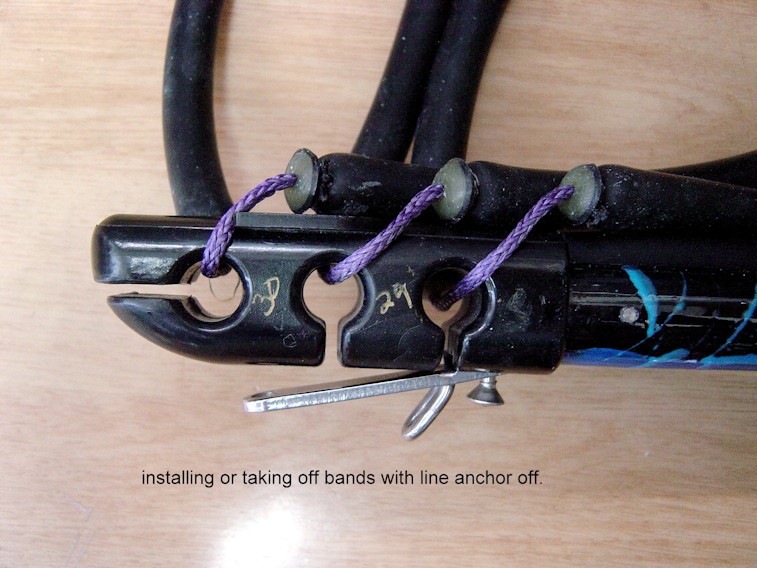
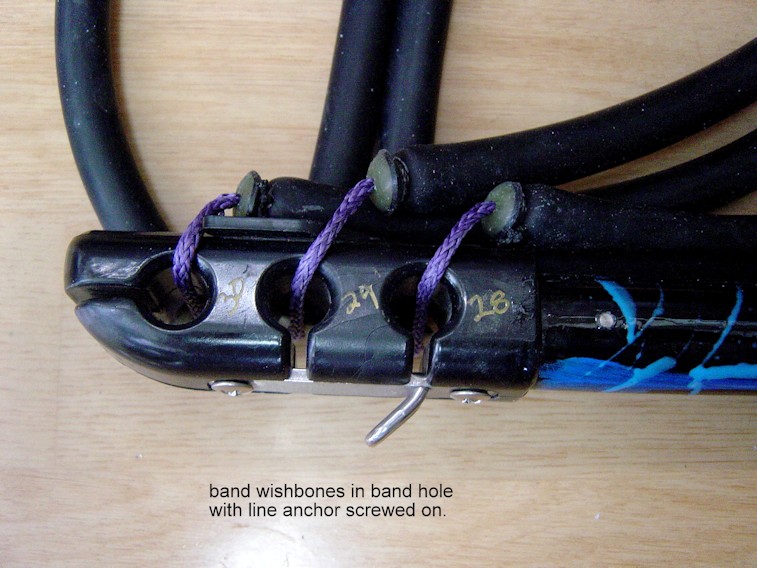
When installing bands into your muzzle, it is important to always make sure you have screwed the SS line anchor tight. This is to prevent breakage of muzzle. Shortest band goes in hole closest to rear of gun. A: Loosen two screws holding line anchor. Open line anchor so that wishbones can be inserted.
B: Once wishbones are into the band holes, it is safe to screw the anchor down.
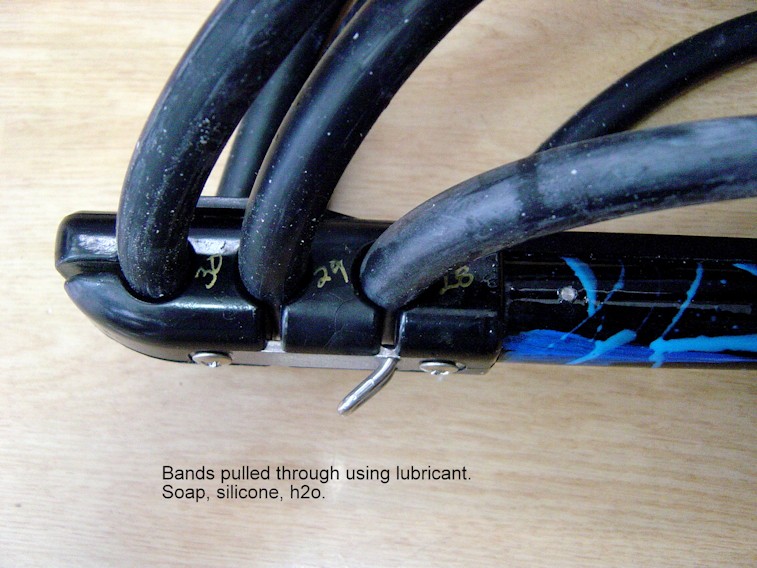
C: Then lubricate the muzzle and pull the band through the band holes. Never attempt loading or unloading bands without lubricant.
How do I remove bands?
Removal is much like installition in reverse.
To remove bands, lubricate bands then pull the bands through the holes so that the wishbones are in the band holes. Then loosen line anchor screws and remove bands.
Loading Tab
What is a loading tab and how does it work?
The loading tab or "Daye" Tab, is a tool to help with loading. A loading tab makes loading the gun much easier and efficient. I use it because the most important thing when diving is to be as comfortable as possible.
Have you ever noticed that the last 8 inches is the hardest to load on the speargun? That is because you have 6 inches of band material in your hand that is not stretching out. The loading tab enables you to catch the wishbone on the tab so that you can relax your hand and let the bands stretch out a little, Then when you pull back the last 8 inches, it can stretch easily. The tab enables us to load without having to exert ourselves which equates to faster recovery time, lower heart rate and longer bottom time. Diving in the Nationals is a perfect example of trying to maximize the amount of bottom time in a set time period. The tab can make a difference especially as you get tired towards the end. Its also a great thing to have in case you want to let a freind, junior, son, daugther or wife dive with you and also be able to load the gun. For all you "Macho" guys, that don't need the tab to load the gun thats great. If anything that loading tab can give you that little edge to get down deeper, stay longer or get back down faster. I always say its better to have it and not need it than need it and not have it on the gun. Also having a loading tab on the shaft does three things. It weakens that section and will always bend there. It will work only for the first two bands and then the last band that is the hardest, won't reach the tab because its buried under the first two bands. And lastly, that has to have some effect on the shafts performance having a 3/4 in sharkfin sticking up on the last third of the shaft. Oh one more thing... You pay a an extra fee to have a loading tab on your shaft when you can have the tab on the side of the gun all the time.
So the loading tab or I should say "Daye" tab since my friend Sheri Daye was the first to try it out and came up with that idea is just a tool to help us be more efficient. I have one on everyone of my guns. Do I use it all the time? No. But most of the time I do. On the big 4 bands guns... you bet. For the divers that might shoot their gun once or twice great you might not need a tab. Dive Hawaii with our gang and you'll be glad to have a tab on the gun. Check out this youtube video and you'll see how the tab is used and how it can be a great asset to have on your gun.
Have fun this season and I hope to see you all in Hawaii one day.
Aiming
I am often asked why a gun shoots a certain way or why doesn't a gun shoot "dead on".
There are many factors that determing how and why a speargun shoots a certain way. Lets look at band power.
I believe that one of the most common problems that divers have with a speargun is misses due to the power of the bands on the gun. We all would like to have a gun that shoots 25ft and hits center mass every time. But the reality is that an increase in band power gives more distance but at a sacrifice in accuracy. For every action, there is a reaction. When there is an increase in forward speed of the shaft, there is also an increase in recoil rearward. This can be seen when firing a pistol. The recoil will also cause the front of the muzzle to lift upward. When this happens, the muzzle will lift the end of the shaft upward as it leaves the gun and cause low shots. Some divers believe that low shots means the gun needs more power while the answer is less power.
Although less power means less recoil and less muzzle lift, it also means less distance. There is a fine line between distance and accuracy. Also some bands have more punch or snap than others. The more snap, means more recoil. Softer bands means less recoil but less distance. It takes practice and experimenting with different bands lengths and band materials before you can find what works for you.
I've shot rifle competitively for over twenty years and no serious shooter buys a gun off the rack without trying different loads of ammo and testing. Why should a serious diver be any different? Pratice makes perfect.
Not everyone is created equal. A 6'2 225# male with twenty inch biceps may be able to hold a gun with four bands and shoot dead on at 25ft. while a 5'6 150# guy shooting the same gun gets a broken nose. It comes down to using the combination of bands and gun that works best for you. Accuracy is always more important than distance.
Next time we can look into sight picture or enclosed vs open tracked guns.
Aiming a midhandle type speargun.
There is a short learning curve to aiming any mid handle style speargun. Unlike a European Rear handle gun where the handle is all the way back, midhandle and Rear handle plus positions can vary from 7-13.5in from the butt of the gun. This means you will be looking over part of the speargun that is behind your shooting hand.
To aim is simple. There are no sights on a speargun. Like shooting a longbow, in archery, you use the tip of your shaft as an aiming point. It is as simple as pointing your finger.
When you point your finger at an object, you are basically extending your arm out and looking at your finger tip is now pointing at the object. Your head is upright and not cocked and looking down your arm and finger. Same thing with a midhandle or rear plus seargun. Just extend your arm lock your elbow and wrist. Point the speargun at the target/fish and use the tip of the shaft as your aiming point. Keep both eyes open, and concentrate on the tip pointing at the spot you want to hit. Then squeeze the trigger. Consistency is the key to being a good shooter. Always keep your head up and lock your elbow and wrist.
Practice makes perfect. You can learn more about how your gun performs in one hour of pool or ocean target practice then 10 hours of ocean diving. Why? Because in a controlled environment you can shoot at a known distance, specific size of target, and a target that is not moving. you will see where your shaft hits, the range of your speargun and also weather you are flinching, jerking the trigger or as most spearos learn... that what looks like 10ft away is actually 15-18ft away!
Trying to take a brand new speargun out to dive without testing it is like purchasing a custom big game rifle and traveling across the world to a safari and then taking your first shot at a charging lion. Of course no one would do that, but why do that with a new speargun?
Spearguns are basically a stick with one or two latex bands propelling a metal rod. If bolted to a table in a vice, it will shoot the same way, same distance each time. No different from any other speargun.
As a responsible diver, we must learn how the speargun shoots and adjust so that it will hit what we aim at.
Targets and Practice.
How can I sight in my speargun? And what can I use?.
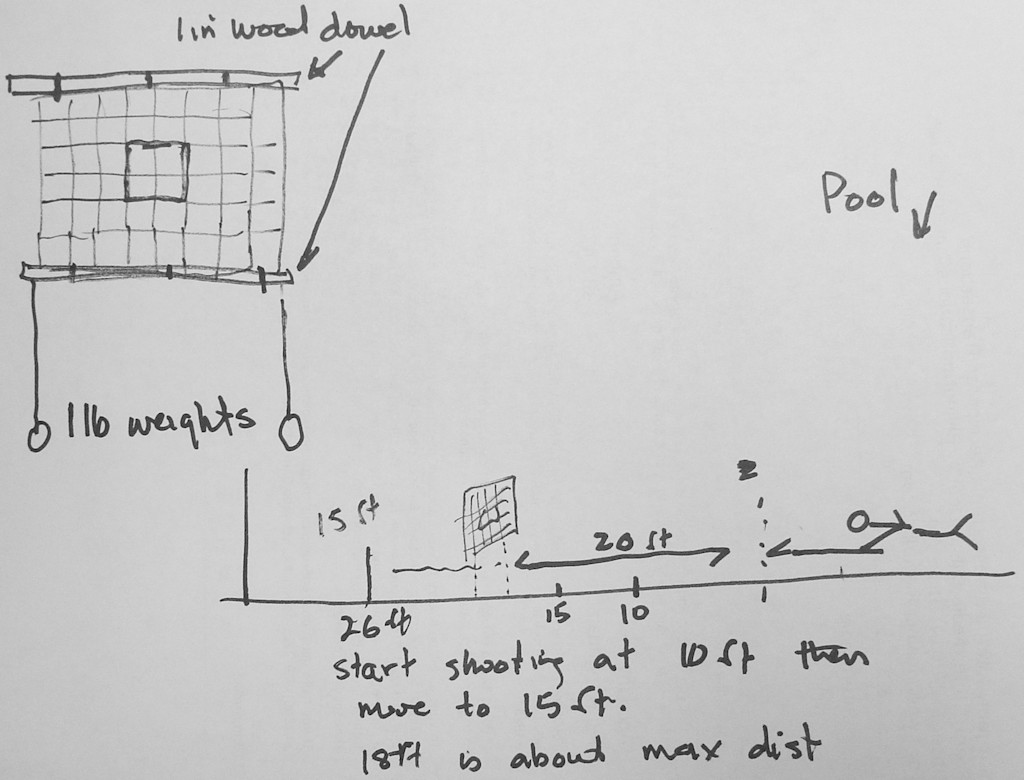
I'm often asked this question by customers who are starting out and also divers who want to get better. Here is the way I make a target to practice in the pool or ocean and How I dial in my gun. These items can be bought at most hardware stores.
1. 2 ft x 3 ft plastic fence material with 1in x 1 in squares or bigger.
2. 2 three foot long 1in wood dowels
3. electrical tape
4. 8 small plastic tie wraps
5 two 1 lb lead weights
The best thing to do is to go to a pool, and use one band. Shoot real close to the target, Once you have that down, then add a 2nd band. when you hit consistently, move back a bit. Once you have that down, then move back. Its how you are sighting. That is why its important to find the right sight picture. If you are cock your head down and looking down the top of the gun and then the tip of the shaft on the target. You will shoot low every time. If you are shooting low, it means you are cocking your head and looking down the bands and over the shaft. If you are shooting low to the right, then you are jerking the trigger. If you shoot high to the left, you are flinching. Make sure you just squeeze off the trigger.
You should be just pointing your arm out and pointing the gun at the target. Then only look at the tip of the shaft and put that where you want to hit. Use the tip of your shaft as your aiming point. Like any rifle, you take it out to the range and dial it in. First at 25yds, then 50 yrds and then 100yds.
Our group uses a 2ftx 3ft square of that plastic fencing material you see around work sites or gardens. Then we put a wood dowel and tie wrap it to the top and one on the bottom. This makes it float. Then we tie a cord to two corners and attach to some small 1 lb weights. This will make the target float upright. In the middle of the target, use some contrasting colored electrical tape. tape out four squares to give you something to aim at.
Since the target has squares, you will be able to see where the shaft is hitting since the shooting line will be going through the target.
Now the important thing is to measure how long the shooting line is. If its 26 ft, then set the target 15ft from the end of your pool and them move back 20ft. This will insure that you shaft won't ever reach the back of your pool. When you are shooting close, move the target towards you. Don't go closer to the target or you'll shoot the back of your pool. Always be shooting from the very back end of your pool so that the shaft will never reach the end of your pool.
By the time the shaft is going to the end of the line its pretty much just falling down. Its the first 15ft that it is zipping.
You will learn more about your gun in an hour of pool testing than ten hours in the ocean. The reason why is that you will be shooting your new gun at a known distance at a known size. In the ocean, you are shooting at a moving target, guessing on the distance and size.
Have fun out there and dive responsibly. If you can't tell if the target is big enough, then its too small to shoot.
Open Track VS. Semi Enclosed Track
The open track hybrid is perfect for the divers who want to upgrade to a gun that is very maneuverable, light, and accurate. Open tracked hybrids are best shot with two 5/8th or up to three 9/16th bands.
The semi enclosed tracked hybrid addresses the shaft whipping issues that can occur with any open tracked gun when powered up. The semi enclosed track takes the shaft whip out of the equation. This semi enclosed track also makes it much easier to load and one of the faster loading guns designed. This is because the shaft has minimal travel on the track before it is in the enclosed section which will automatically guide the shaft into the mechanism.
Size of Spear Gun
What can I say? The bigger the gun the longer the range. Size is usually determined by the visibility and the type of game hunted. In very low vis. 2-5ft. a very small gun such as a pistol would be best. In vis. 5-10ft. then the 42in or 90cm range is great. For vis better then 10ft then sizes from 50-60in work. Fish size should be a factor too. For fish under 10lbs the 50 in or smaller will do fine. For longer shots on bigger fish then sizes upward from 55-63 in may be needed. Blue water diving should use guns that are a minimum of 60-68 in. Bands on those guns can range from three to five bands.
One thing to remember: Always be conservative and know the effective killing range of your speargun. It is our responsibility to ensure that we be sportsmen and try to use the right tool for the right job.
Reel Vs. Float Line
There is a big controversy of weather to use a reel or a float line. But really there isn't any. It just comes down to the situation, conditions and preference. Float lines are the standard for most bluewater diving and they are also used by many all over the world to hunt fish. It gives you the advantage of having a line you can use to fight large fish without losing your speargun. In openwater, and reefs it is an advantage to be able to play the fish with the float line. Fish are easier to control with the float line.
It does have its downside too.
In areas with many rock outcroppings it can get tangled on the rocks or in areas that have think kelp, it can get hung up in the kelp canopy.
Reels are great in that you have the flexibility to be able to swim in and out of caves, ledges, and if there is a thick canopy of kelp you can go through it without entanglement. It also is great for diving in areas with current. You can swim without having a float line being pulled by the current. A reel is basically a glorified reservoir of a very thin float line. It holds from 50-100 meters of line. The disadvantage is that the thick line is harder to control fish with and if used in blue water, there is the danger of being spooled by a big fish and losing the gun.
The best thing to do is determine where you will be diving and the local conditions. Is there kelp, how big are the game sought and is there enough line for the depth and fish you will be targeting.
Spring steel shafts vs stainless shafts
Often I'm asked why coated spring steel rather than a stainless shaft. Both shafts have their advantages and disadvantages. I'm not opposed to one or the other. I see shafts as just part of the equation used with our tool to harvest game. In some instances a stainless shaft is better to use and others a coasted spring steel shaft.
Coated spring steel shafts have been around a long time. Its been the shaft of choice throughout Europe for decades and probably the most common shaft found around the world. Its very inexpensive, has a rockwell hardness of 50-52 and comes in sizes from 6.6mm, 7mm, 7.5mm,8mm and larger. The advantage of the Rockwell hardness is that it is very stiff. For small diameter shafts normally found on the smaller Euro style guns 90 cm and smaller, it has less flex, holds an edge longer and bends less than a similar sized stainless shaft. For open tracked guns this is a definite plus. Most of the coated spring steel shafts are coated with a galvanizing layer that inhibits corrosion. Eventually wherever the coating is scratched or abraded off, it will rust there. Normally the tip area. Coated spring steel shafts can last a long time with proper care. After diving, its recommended to remove the shaft, rinse with fresh water, dry, and then a light coat of oil applied with an oily rag. Shafts cared for can last years. Because of the rising steel prices, shafts both spring steel and stainless are increasing in price every year. I look at the spring steel shafts as something that is disposable. Its inexpensive, and when it finally has outlived its usefulness, it can be discarded or become a back up shaft.
Stainless steel shafts are very popular because maintenance is minimal, Good stainless shafts are usually made from 17-4 stainless steel and heat treated to H-900. This gives the shaft a rockwell hardness of 38-41. It is stiff, but compared to a spring steel shaft, it is much less stiffer and can bend a lot easier. If the rockwell hardness is increased higher, it made the stainless shaft more brittle. Stainless steel 17-4 H900 is pretty much the industry standard used by most of the companies providing stainless shafts on guns. It is a stainless alloy using chromium/copper precipitation hardening stainless steel used where high strength and moderate corrosion resistance is needed. Because of rising steel prices along with the other alloys in the stainless steel, the price of a stainless shaft can be very costly. Upwards to 25% or more than a similar spring steel shaft.
Personally I use both shafts depending on the application. Spring steel shafts because of the lower prices, and stiffness vs the more costly stainless shafts are an economically better shaft to use on the guns that I use most often. They bend less, dull less and perform better with less flex. I just spend a little more time to care for it. And when its time to throw out the shaft, its less costly vs a stainless shaft that is 25 % more. There are some custom stainless shafts that are sold for upwards to 100.00 USD per shaft vs 50 USD of a spring shaft . I would rather have two shafts for the price of one. For blue water, I use stainless shafts because on many trips there is not the time or conditions to be able to care for the spring steel shaft like they should, so a stainless shaft is easier to care for. Most blue water guns will not be shooting fish as often as a smaller reef gun and a stainless shaft works just fine.
I also like the Spring steel shafts because they give me many options on the size of the shafts that can be used. Most of the fish targeted can be landed using one or two sizes. 7mm (9/32in), or a 7.5mm shaft. I find the 7.5mm shaft a perfect blend of size and stiffness that gives better performance than a 5/16 stainless shaft. Its lighter, stiffer, needs less band power. This means better distance, straighter with less flex, and less bending. For anyone shooting fish such as Groupers, this is a good choice. There are many commercial spearfisherman who use this size to harvest groupers.
So what shaft should you use? Use the shaft you feel will work best for your needs. If you want a shaft that is low maintenance and don't mind the higher cost, then a stainless shaft is great. For those that dive often and want an inexpensive shaft that is stiffer, bends less and dulls less then a spring steel shaft is great. If you go through a lot of shafts over the year, you might consider a spring steel shaft.
Mixed Woods
There are a lot of spearos that like me enjoy building a gun that they can take out to use and enjoy.
I think that you should all be commended for wanting to build your own gun. For those of you that have the basic tools.it is not all that hard. It just takes some good planning and lots of elbow grease.
Just a few things to consider when using different woods. I have pretty much worked with all the woods available. Being a custom gun designer that offers a lifetime warranty, I have pretty much gone back to basics and use only Teak. Why? Because it is the most stable of all the woods to work with, Its fairly easy to acquire, and I rarely have problems with warping and delamination with my solid gun stocks or the laminated stocks on blue water and enclosed tracked guns.
Here is what I have found while working with four commonly used woods . All are very nice woods to work with and they have advantages and disadvantages when working with them.
Oak: It is a very hard dense wood with nice grain. It can be found with very little or no knots or many. It does not rout easily and tends to splinter in sharp pieces so eye protection is a must. Of course that should be standard for anyone working with power tools. I have found that the oak tends to warp very easily. Even when laminated. IT also likes to soak moisture in through any little break in the stock. Screw holes, scratches, etc. A strong seal and good finish is a must. It also tends to get dark wood rot stains wherever moisture can seep in.
A very well known company that makes probably the most wood stock guns sold, used to have oak and teak laminated guns. They are no longer available due to the warpage and because the two woods have different coefficient expansion rates the stocks would delaminate with time. It happened to me too.
Mahogany: It is a soft wood, easy to work with. but very porous. Its pores are like a sponge and if moisture gets to the stock, it also turns dark. It has the advantage or disadvantage being very buoyant. I used to make Ballast wings (yes me too before I saw the light) out of this material because I could add a greater amt of ballast due to mahogany's buoyancy. It is very important to get a good seal in this wood too. Many manufacturers like this wood because it is readily available, easy to work with and cheap. Almost half the price of teak.
Purple heart: I fell in love with the looks of this wood the first time I saw it. Who would have though nature could make a wood purple! The down side of this wood is that it is very brittle like oak, and tends to splinter. Also it warps easily too. I loved the look, but hated working with it because of all the splinters I would get while working with it. Another down side is it will blacken wherever water contacts the wood. Around the screw holes in the track etc.
Also with time it will turn a lovely tan or brown color as the uv rays fade the wood. It is pretty dense wood.
Padauk: This wood is very dense and tight grained. Splinter city unless sharp blades are used. It is not very buoyant and I had a few guns sink on me. The big downside is that the dust from this wood is very bad. You need to be very careful of the dust when sanding and working with this wood. This wood will also turn color with time.
One thing to remember is that you should try not to mix woods. There are those that do and make beautiful guns, but when push comes to shove, a laminated stock of all the same wood will have less chance of warpage or delaminating. Want to hear something hilarious? Many years ago when I first got into this seriously, I decide to make the most beautiful gun and used all of the above in a laminated stock. I was so proud of it that when I took it out for the inaugural dive, neadless to say my ego was devastated to see that not only was it delaminating, but it had warped after only a days diving. It had four coats of epoxy and was finished as best as I could do at that time. It was just that the different woods all expanded differently and the epoxy could not overcome the expansion rates.
Another tip is too make two guns. Have a cheap piece of pine or inexpensive wood and do the first cuts and routs on that piece and then do the final one on the stock you are going to use. Better to make a mistake on the cheaper wood. Then just putt he practice stock away.
The bottom line is that no matter what you use there is ALWAYS the chance of delaminating, warpage. Checking of the wood, dark wood rot, etc To lessen the occurrence, stick with one wood, and try to use a very dense stable wood like Teak. I know our rainforests are diminishing but there really isn't a substitute for Teak. For those that mix woods, good luck and seal everything well.
Again congratulations to all you that will take the journey and build you own gun. But remember to not cut corners and make your gun as safe as possible. No matter who's hardware you use, the only safe speargun is an unloaded one.
::
,
Perfect gun for medium visibility. - Ian Mg,
